Huge congratulations to the X-DE-MAN team and partners (@MORE, @UNIPR) for this impressive proposal and the clarity of vision behind it.
De-manufacturing training is, in my opinion, one of the most relevant and under-explored use cases for XR today. It sits exactly at the intersection of industrial know-how, human-centric design, safety, and circular economy. Training operators not only to assemble, but to disassemble responsibly, safely, and efficiently is a key enabler for sustainable industry—and XR is uniquely suited for that mission.
What really stands out in X-DE-MAN is the way immersive training, real-time guidance, and competency-based learning are combined into a coherent operational workflow, not just a “nice VR demo”. Allowing operators to rehearse complex disassembly tasks in a risk-free environment, then supporting them on the shop floor with contextual guidance, is exactly how XR creates tangible value for Industry 5.0.
It’s also great to see such a strong and well-used foundation with the enabler INTERACT. For those who may not know it, INTERACT is a physics-based XR simulation and training platform designed to create realistic, interactive industrial scenarios. Using INTERACT for de-manufacturing training makes perfect sense: realism matters when teaching how components behave, how forces apply, how errors happen—and how to avoid them.
Bravo to the whole team for the vision, execution, and ambition
Looking forward to following X-DE-MAN’s journey from TRL5 to real-world deployment—and to seeing more de-manufacturing and circular economy use cases powered by XR.
Participatng in the X-DE-MAN academic validation was a very fascinating experience. Altough it was my first time approaching virtual reality (VR), the tools were easy to use and the instructions clear. Also, I deem noteworthy the possibility to keep on glasses during the simulation, as it allowed me to properly see what I was doing.
I think this project has great potential in helping to learn specific disassembly tasks faster, compared to traditional memorizing methods.
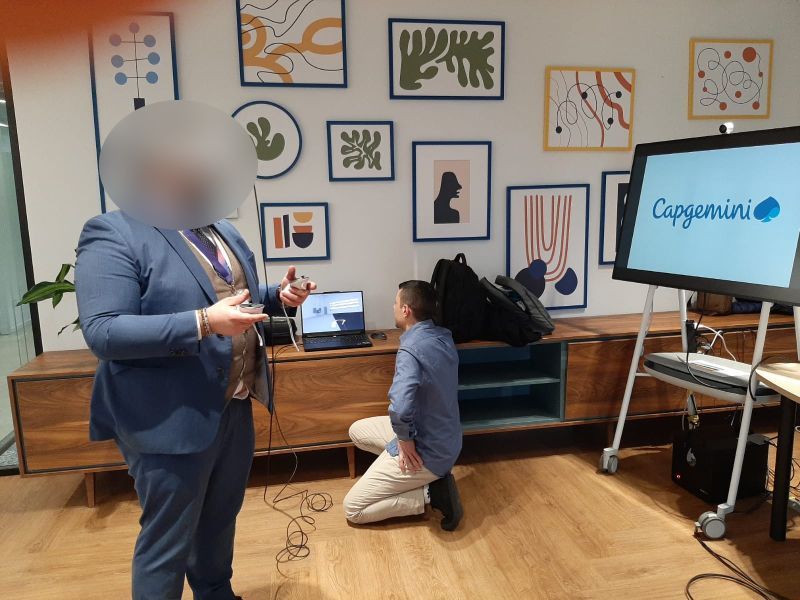
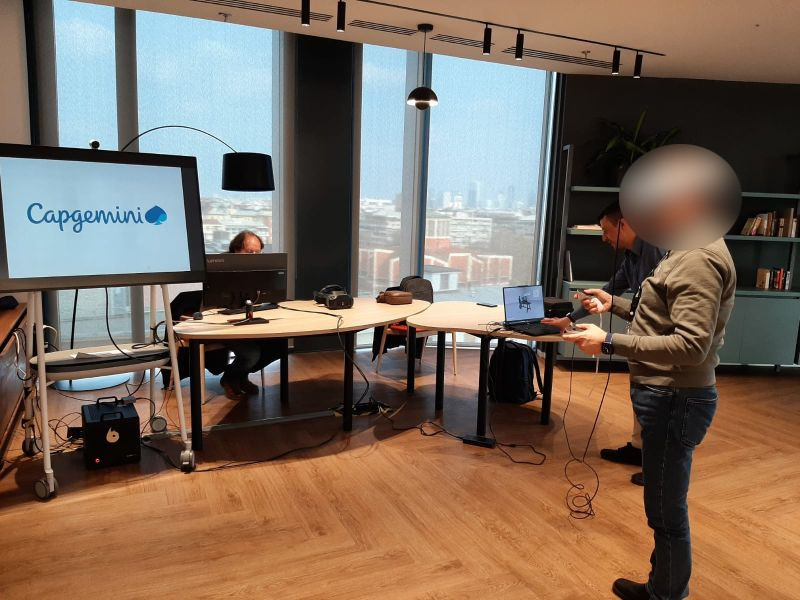
We’re officially stepping into the growth phase, engaging new prospects and bringing our solution closer to real-world impact. And what better way to do it than taking it on the road? This time: Milan.
We had the chance to present X-DE-MAN to Capgemini Engineering, showcasing its application in the engineering domain. The result? A room full of curiosity, great questions, and genuine interest - the kind that makes you realize you’re onto something valuable.
So much so that they’ve already asked us to come back (we promise we didn’t bribe them with espresso ).
A huge thank you to @xr2learn-admin for making this journey possible and for believing in the vision from day one.
We are actively moving forward in the growth phase, presenting the results of the project and the X-DE-MAN platform to new potential stakeholders across different sectors.
This time, we stepped into the aerospace domain, showcasing our platform to Airbus.
The result? Strong appreciation, valuable feedback, and insightful discussions - the kind that not only confirms the potential of what we’re building, but also opens up new perspectives on how the platform can evolve and be applied within the aerospace industry.
Moments like these are key: they help us refine our vision, strengthen our solution, and explore new frontiers where X-DE-MAN can make a real impact.
How can digital tools make product disassembly smarter, faster, and more standardized?
Prof. @ClaudioFavi explored this in his presentation at CIRP LCE 2026 in Tokyo: Evolution of the disassembly map towards a standardized and software-readable format for virtual product disassembly.
Funded by the XR2Learn consortium, this research is shaping the future of circular manufacturing by making disassembly processes software-friendly and ready for automation.
The conference paper will be released online in the coming weeks. In the meantime, here’s the presentation - take a look and share your thoughts! Presented on 11/03/2026 at CIRP LCE 2026, Tokyo
Thank you for sharing this! It was a pleasure presenting our work at CIRP LCE 2026 and collaborating with such an amazing team.
I’m looking forward to seeing the full paper online and continuing the conversation on how digital tools can advance circular manufacturing and virtual product disassembly.
How can XR technology empower the next generation of manufacturing operators?
I had the pleasure of presenting our work at CIRP Design 2026 in Tokyo: Towards a novel XR-driven platform for Operators 5.0 upskilling in product disassembly. A huge thank you to all my co-authors, @ClaudioFavi , Eleonora Fiore, and Aurora Spaggiari, for their incredible contributions, and to the XR2Learn consortium for funding this research.
The full conference paper will be published in the coming months. In the meantime, I’m excited to share insights from our presentation and hear your thoughts on XR-driven upskilling in manufacturing! Presented on 18/03/2026 at CIRP Design 2026, Tokyo oc26. Announcements4. Showcase7. Networking
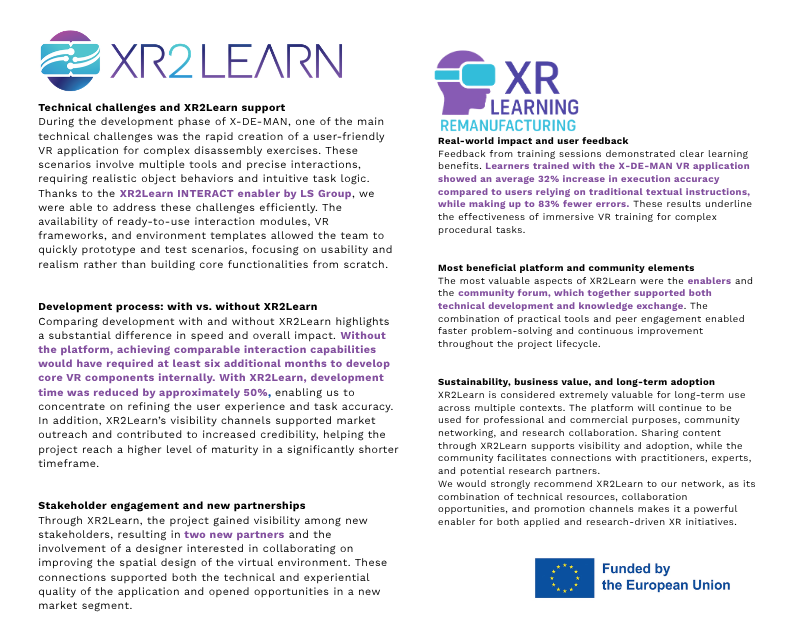
[TESTIMONIALS] Curious About the Added Value of XR2Learn?
Would you like to know more about the experience?
Discover first‑hand feedback from an XR2Learn OC2 winner, sharing their experience and key learnings from using the platform. Thank you for sharing this experience with the community!


 ).
).


 Presented on 11/03/2026 at CIRP LCE 2026, Tokyo
 It was a pleasure presenting our work at CIRP LCE 2026 and collaborating with such an amazing team.
 How can XR technology empower the next generation of manufacturing operators?

 Curious About the Added Value of XR2Learn?