Based on policy work led by our project coordinator within XR2Learn, we’d like to open a discussion around a key recommendation here and want to hear from you!
XR in education: what’s really slowing adoption?
With the green and digital transitions accelerating (think Digital Twins, AI, automation), industry is evolving faster than ever.
But education and training? Not quite keeping up.
 This creates a key challenge:
how do we equip the workforce with the right skills, at the same speed as industrial change, while keeping a human-centric approach?
XR (VR, AR, MR) is often seen as a powerful solution—enabling immersive and adaptive learning.
Yet, its adoption in education is still limited.
One major reason:
creating XR content is still too complex and inaccessible for most actors.
 Policy Recommendation #1
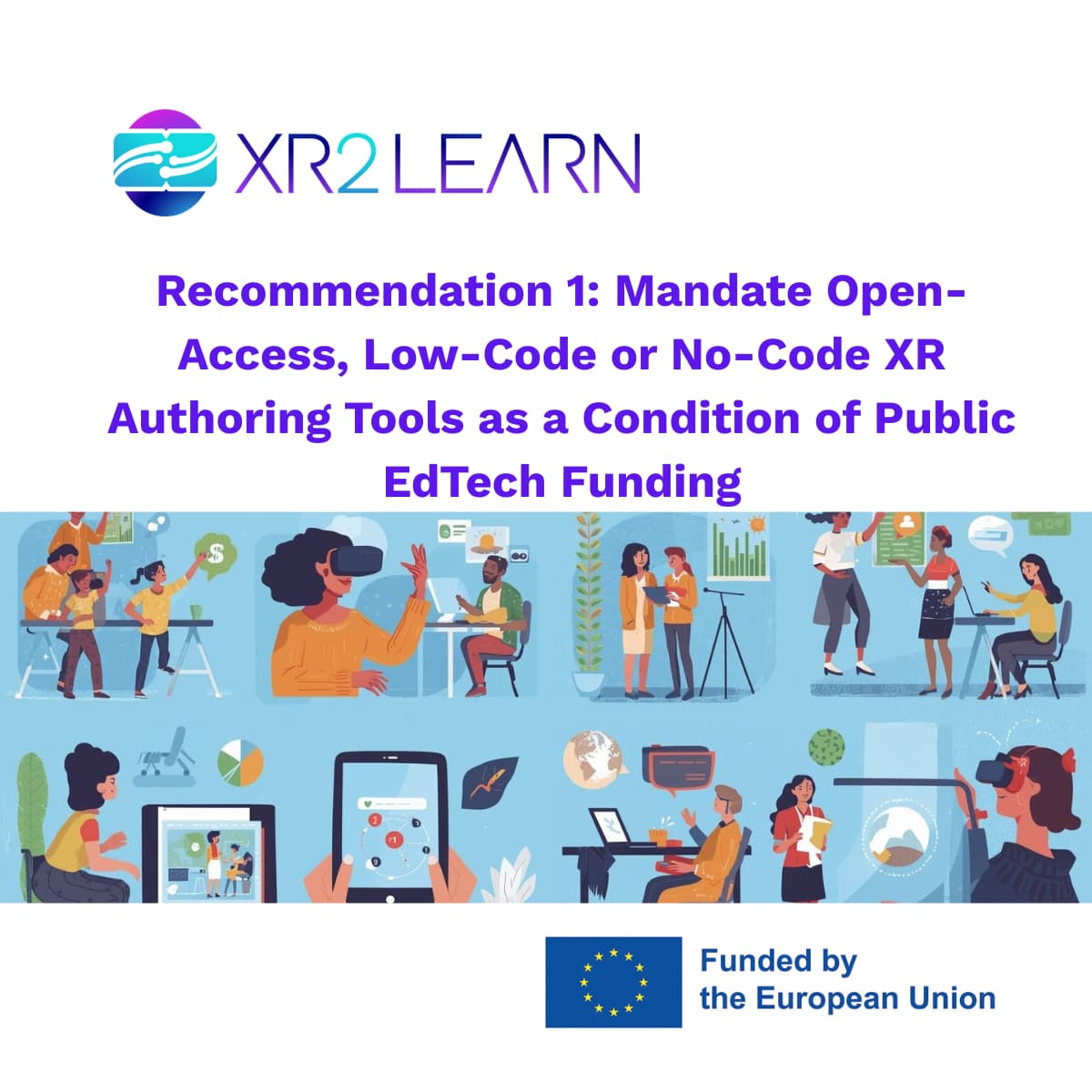
A proposal emerging from XR2Learn is to make open-access, low-code / no-code XR tools a requirement in publicly funded projects (e.g. Horizon Europe, Digital Europe, ESF+).
Not just funding content, but funding tools that others can reuse.
Why?
Because today many results remain proprietary and hard to scale.
XR2Learn already showed a different approach:
the INTERACT no-code tool enables even small teams to build advanced XR training scenarios—without specialised programming skills.
The takeaway:
if tools are accessible and open, XR creation becomes scalable across the ecosystem—not just limited to a few players.
 What do you think?
- Would this kind of requirement actually accelerate XR adoption?
- Are SMEs and training providers ready to use these tools?
- What could hold this back?
This article is based on scientific and technical results from the XR2Learn project , funded by the European Commission under Horizon Europe (Grant Agreement No. 101070300).
The policy recommendations presented here were developed under the guidance of the XR2Learn Consortium Coordinator, Prof. Ioannis Chatzigiannakis (Sapienza University of Rome and CNIT, Italy).
 Evidence from XR2Learn